The U.S. Chamber of Commerce's Small Business Survey found that 89% of small businesses now use AI in some capacity, up from just 36% in 2023 — one of the fastest technology adoption curves ever measured for this segment. That number alone suggests small businesses have solved the automation problem. The more detailed data says otherwise.
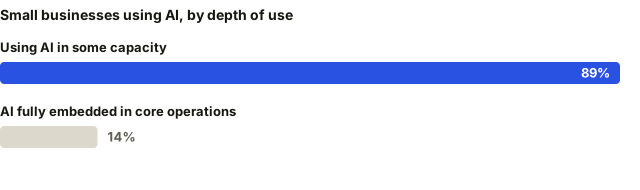
Source: U.S. Chamber of Commerce Small Business Survey
The same body of survey data shows a much narrower reality underneath the headline figure: most businesses that report "using AI" are running a single tool for a single task — content drafting, an email assistant, a chatbot widget — with only a small minority reporting AI as fully embedded in core operations. Multiple sources converge on the same shape of finding: adoption of at least one AI tool is now closer to universal among small businesses, while deep, multi-system integration remains rare.
This isn't a willingness problem. It's a tooling problem. Wiring one AI tool into a workflow is a weekend project. Wiring five systems together — the CRM, the inbox, the spreadsheet, the invoicing tool, the support inbox — into something that actually runs unattended requires either a developer on staff or a platform built specifically to be configured without one. Most small businesses have neither, so adoption stalls at the single-tool layer even while appetite for more keeps climbing.
The businesses reporting revenue gains from AI are disproportionately the ones that got past single-tool use into connected automation — the survey data ties multi-tool, embedded use to measurably better outcomes than single-tool dabbling. That's the gap worth building for: not more AI features bolted onto individual apps, but the connective layer that turns five separate tools into one system that runs itself. It's also, not coincidentally, exactly the gap a plain-English, self-hosted workflow builder is positioned to close.